
A missing tooth changes more than your smile. Chewing goes lopsided. Words come out funny. Photos? You start dodging them. Imagine a 34-year-old patient who loses a molar while playing cricket.
Patients often ask whether a dental implant or a bridge is the better option. The honest reply is the same every time: it depends. Annoying, but true. Dental implants can last for many years and help maintain the jawbone around the implant site, but treatment may take several months and cost more initially.
Bridges can often be completed in a few weeks without implant surgery, but they rely on supporting teeth. Neither wins every category. Anyone selling one as the universal answer is guessing. Patients in Chattogram can consult Dr. Masum’s Dental Clinic to discuss tooth replacement options and whether CBCT imaging is needed for treatment planning. Book a consult and the right call for your mouth becomes obvious.
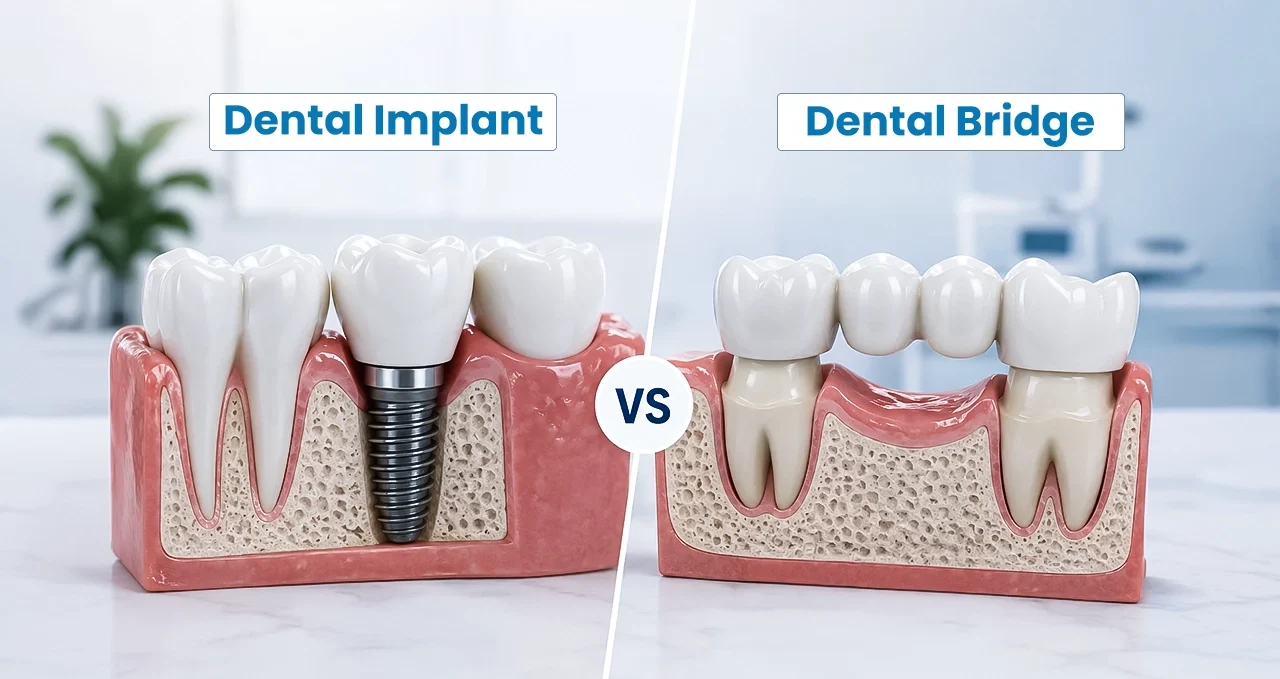
Both fill a gap. The mechanics are the opposite. An implant is a titanium screw sitting in the jawbone, a fake root, in plain terms. A bridge skips the bone entirely. Two teeth flanking the gap act as anchors. A false tooth hangs between them. From that one design choice, every other decision flows.
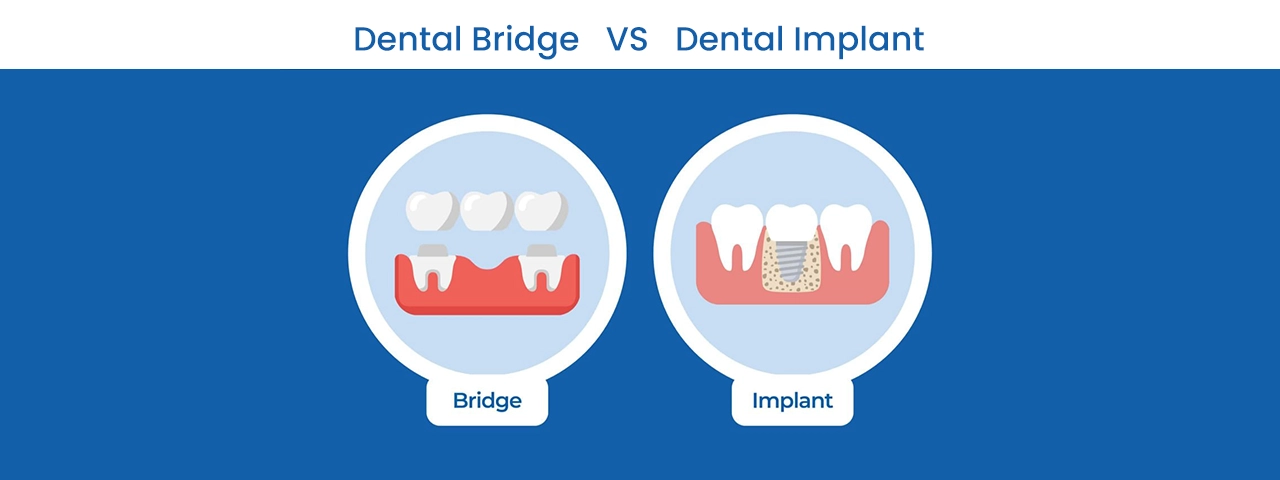
A dental implant is a small post, usually made of titanium or another biocompatible material, that is placed in the jawbone to support a replacement tooth. The dentist seats it into the jawbone where the original root used to live. On top of the screw sits a small connector piece called an abutment.
The crown is the part that actually looks like a tooth, it goes on top of the abutment. Here’s what surprises people: bone grows onto the titanium over a few months. The clinical term is osseointegration. Once osseointegration is complete, the implant provides stable support for the replacement tooth. An implant can provide stable chewing function, although it does not feel exactly like a natural tooth because it lacks the periodontal ligament.
A bridge takes the opposite approach. No bone work. No surgery. The dentist prepares the supporting teeth to make room for the crowns that will hold the bridge in place. An impression goes to the lab. The lab returns a three-tooth unit: two crowns with a fake tooth suspended between them. The whole unit gets cemented onto the prepared teeth. A conventional bridge often requires multiple visits, including tooth preparation, impressions and final placement.
So the real question: new root in your bone, or use the teeth you already have as anchors? Both can work. What decides it is the neighbor teeth, your bone quality, and your timeline.
Better for what? That question lands every week. And the reply is always another question. What’s the hurry? What’s the budget? What shape are the teeth next to the gap? Consider a patient in her mid-40s who has lost a premolar and needs a replacement before an upcoming event. She wanted teeth before her daughter’s wedding in eight weeks. Bridge was the obvious call.
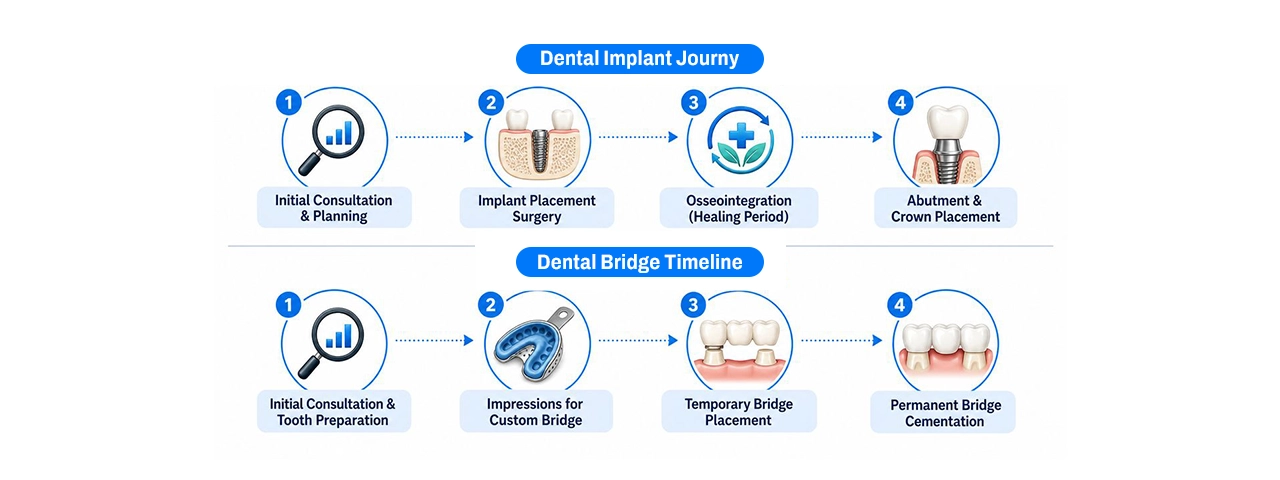
Implant placement counts as minor surgery. First the dentist numbs the area. After numbing the area, the dentist prepares the implant site and places the implant in the jawbone. The gum may then be closed with stitches, depending on the technique used. The gum gets sutured closed over it. Then comes the wait. Bone needs three to six months to grow onto the post. Once solid, the dentist reopens the gum, attaches the abutment, takes an impression, and a couple weeks later the crown goes on. The full treatment may take several months, depending on healing, bone condition and whether additional procedures, such as bone grafting, are needed.
A bridge skips all of that. One visit, the dentist preps the teeth, takes impressions, puts on a temporary. Two weeks later the lab sends back the permanent bridge and the dentist cements it in. A conventional bridge does not require implant surgery or osseointegration. After the supporting teeth are prepared, a temporary bridge may be fitted while the permanent restoration is made. If you need a replacement within a short timeframe, a bridge may be worth considering. If the adjacent teeth are healthy and you want to preserve them, an implant may be another option, provided your clinical assessment supports it.
Implants are tough. There are patients walking around with implants placed in 2005, 2006, still going strong. A successfully integrated implant can last for many years, although complications and implant failure remain possible. The crown may need repair or replacement over time due to wear or damage, even if the implant itself remains stable.
Bridges are different. Dental bridges can last for many years, but their longevity depends on the condition of the supporting teeth, the materials used and oral hygiene. The bridge itself isn’t usually what fails. It’s the supporting teeth underneath. Get a cavity on one of those teeth under the crown and the whole bridge has to come off to fix it. That’s the weak link.
Cosmetically both look like real teeth. The lab matches the shade to your other teeth and shapes the crown to fit your bite. From the outside nobody can tell. The main difference is how they feel during chewing. Because an implant is supported by the jawbone, it can provide a stable chewing function. The sensation may still differ from that of a natural tooth. A bridge sits on cement and gum, so there’s a tiny bit of give. Some patients notice that flex, some don’t.
For more information about how dental implants replace missing teeth and what the treatment involves, read the American Dental Association’s guide to dental implants
Both have real downsides. The right pick comes down to your mouth and your budget.
A dental implant can provide long-term tooth replacement when treatment is successful and proper maintenance is followed. An implant transfers chewing forces to the jawbone and can help maintain bone in the implant area, although it does not prevent all bone loss. The neighbor’s teeth stay untouched. Trade-off: surgery, months of waiting, and a higher upfront bill. Some patients also need a bone graft before placement that adds time and money.
A dental bridge often offers a shorter treatment timeline and lower initial cost than an implant, although the exact time and cost depend on the case. But the dentist has to cut into the neighbor’s teeth to fit the crowns, even when those teeth are perfectly healthy. Those teeth then carry the load for the missing one. If one fails down the road, the whole bridge comes off.
Don’t pick based on which one sounds nicer in a blog post. The right answer depends on facts you can only get from an exam and an X-ray.
If the teeth next to the gap are virgin, meaning no fillings, no crowns, nothing better not to touch them. An implant goes between them without grinding anything down. Bone quality matters too. If your jaw is dense and tall enough to hold a post and you’ve got the patience for a four-to-six-month wait, the implant tends to be the better long-term play. Bone loss can occur after a tooth is removed. An implant may help maintain bone around the implant site, but it cannot prevent every type of bone loss.
If the adjacent teeth already need crowns or extensive restorative treatment, a bridge may be a reasonable option in some cases. Prepping them for a bridge isn’t wasting healthy tooth structure as those teeth needed crowns anyway. A bridge also makes sense if you can’t have surgery, or if you’ve got an event in two months and need teeth by then. Every case gets assessed in person. The decision depends on your X-rays, bite, oral health and treatment preferences. Not on a checklist from the internet.
There’s no sticker price that can be given over the phone. The bill depends on too many variables. How many teeth are you replacing? What material is the crown? Zirconia runs more than porcelain-fused-to-metal. Do you need a bone graft first? Two patients with the same missing tooth can walk out with very different totals.
Here’s what gets told to everyone. An implant costs more up front than a bridge, no way around that. Although implants often have a higher initial cost, their long-term cost depends on maintenance, crown replacement and whether additional treatment is needed. A bridge may also need repair or replacement over time, depending on its condition and the health of the supporting teeth.
Every replacement means more drilling on the supporting teeth. Look at the total over a decade and the cost gap narrows. Over the long term, the total cost of either option depends on its initial price, maintenance and any future repairs or replacements.
The bridge came out, the cracked tooth got pulled, and two implants went in. She said she wished she’d done the implant the first time. The only honest way to price your case is to come in for an exam. The numbers for both options get laid out before you decide anything, no surprises.
Cleaning matters more than people think. Plaque collects on a fake tooth the same as on a real one. Plaque can accumulate around both restorations, so regular cleaning is essential. Poor cleaning can lead to gum inflammation, bleeding or recession around an implant or bridge. The cleaning routine for an implant and a bridge has a lot of overlap. The one big difference is the bridge as there’s a tricky spot underneath that you absolutely cannot skip.
Implant cleaning is pretty straightforward. Twice a day, fluoride toothpaste, floss around the post. The contact points are tighter than on natural teeth. That’s where a floss threader or an interdental brush comes in. Attend dental checkups at the interval recommended by your dentist. During follow-up visits, the dentist checks the implant, surrounding gums and oral hygiene, and provides professional cleaning when needed. A bridge is a different animal.
Food traps under the false tooth, and a regular toothbrush can’t reach that spot. You need a floss threader to slide floss under the pontic, the fake tooth in the middle, and work it back and forth. An interdental brush is handy if there’s space. This is a nightly thing. If plaque builds up around the supporting teeth, the risk of decay and gum problems increases, which can affect the bridge’s longevity.
Both implants and bridges replace missing teeth, that part isn’t in dispute. They just go about it differently. The implant sits in your bone and stays for decades. The bridge sits on your neighbor’s teeth and gets you teeth in two weeks. Your bone, your timeline, your budget, those three decide which one wins. Don’t make this call on price alone. When comparing costs, consider the initial treatment, ongoing maintenance and possible future repairs or replacement. Book an appointment to Dr. Masum’s Dental Clinic and the right option for your mouth becomes clear.
Usually, yes. Dental implants can last for many years, and bridges can also provide long-term service. Their longevity depends on oral hygiene, restoration condition, supporting teeth and regular dental care.
To fit a bridge the two neighbor teeth have to be shaved down. If the adjacent teeth already need crowns, a bridge may be suitable in some cases. Your dentist should assess whether preparing those teeth is appropriate. If they’re perfect teeth, well, that’s a real trade-off.
The surgery itself is about an hour. Then comes the wait, three to six months for the bone to fuse. After that, the abutment and crown go on. The whole thing usually takes four to eight months.
Brush twice, floss daily, see the dentist every six months. With a bridge, thread floss under the false tooth every night. With an implant, keep an eye on the gum around the post for any inflammation.
Consider your jawbone condition, the health of adjacent teeth, budget, treatment timeline and suitability for surgery. A dentist can assess these factors and help you compare the long-term benefits and limitations of both options. Don’t pick on price alone. You know, a bridge that fails in ten years costs more than an implant that lasts thirty.

Stay connected with us on social media for the latest updates, offers, and more. Join our community!
Momtaz Height (3rd Floor), Beside to NCC Bank, Opposite to Islami Bank, Boropol Moor, Halishahar, Chattogram
+880 1778 912823
Copyright © 2026 by Dr. Masum’s Dental Clinic | All Rights Reserved. Powered by Marketing Bee