
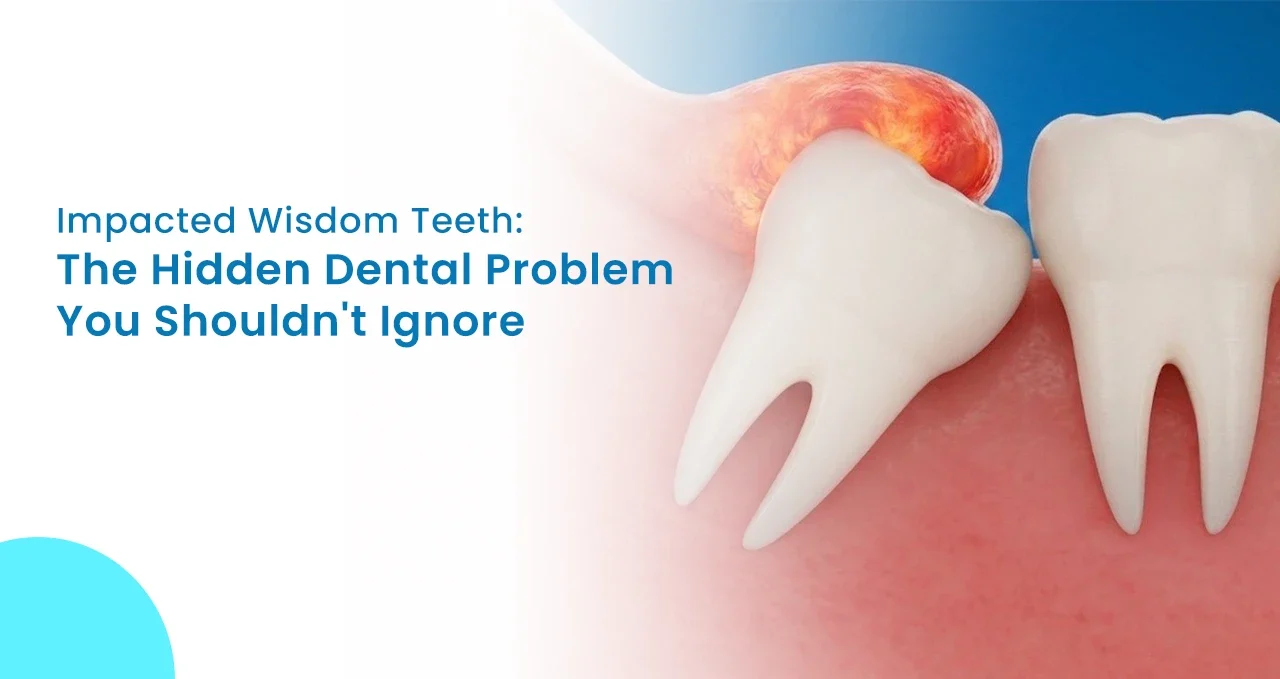
Your wisdom teeth are often a silent troublemaker hidden inside the mouth. Especially when the impacted wisdom teeth cannot come out properly, dental problems, gum pain, and swelling start slowly, which you may not notice at first.
Impacted wisdom teeth mean that the tooth is not able to rise properly and is stuck inside or growing in the wrong direction. It can damage not only your oral health but also the adjacent teeth. Sometimes the problem grows so slowly that people generally ignore it.
In this blog, you will know how impacted wisdom teeth become a hidden dental problem, when it becomes dangerous, and when you actually need wisdom teeth removal, very simply and clearly, so that you can understand your own situation.
Wisdom teeth are the teeth at the very back of our mouth, commonly called the third molar. These teeth usually come in late, and many times people don’t realize when they’re coming in or how they are developing.
Wisdom teeth, which we call molars and third molars, usually come in late in life. At this time, wisdom teeth start to grow and slowly try to erupt. Generally speaking, these teeth usually come in the late teens or early twenties.
This is when most permanent teeth are fully developed. That is why it is said that wisdom teeth are the last teeth, because they are the last teeth in the mouth.
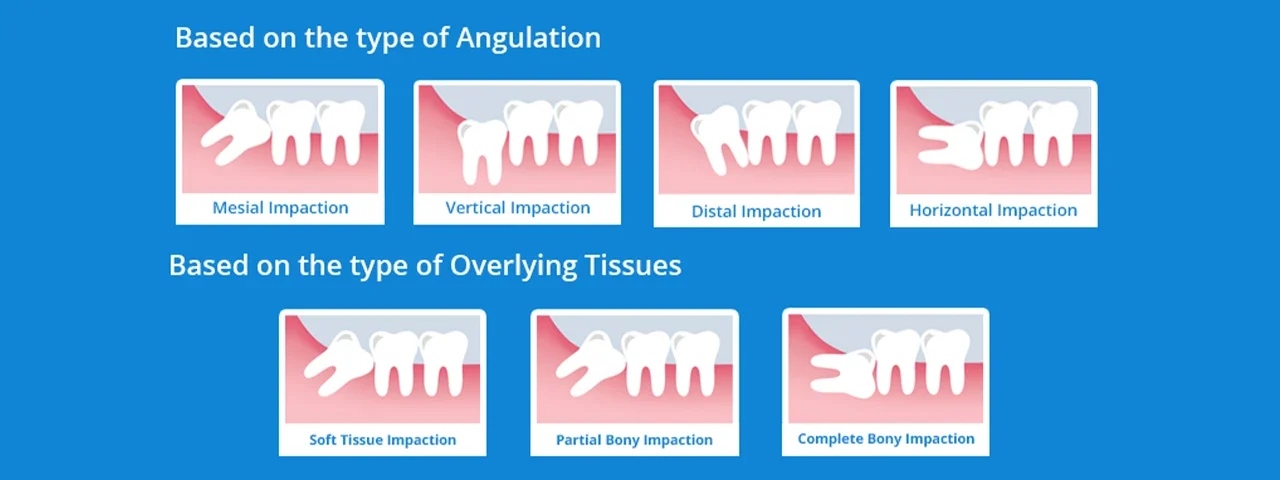
The types of wisdom teeth differ based on their angle or position in the gums. Generally, they can arise in 4 ways:
It is mainly due to these positions of the teeth that the pain pattern varies from person to person.
Impacted wisdom teeth are a condition where the wisdom teeth cannot erupt properly or are partially stuck. Sometimes they grow in the wrong direction, and this is where real problems begin, often unnoticed at first.
Impacted teeth refer to wisdom teeth that cannot erupt naturally. These impacted wisdom teeth are usually stuck inside the jaw or pressed against adjacent teeth. Many times these teeth may grow in the wrong direction, due to which the entire alignment is lost.
Such problems are usually detected through routine dental X-rays. And this is why regular dental check-ups are so important, because if not caught early, the problem will gradually grow and affect your oral health.
When impacted teeth cannot erupt properly, it gradually starts creating various dental problems. At first, it may seem small, but over time, it can have a big impact on the overall oral health of the mouth.
Now this is how these problems usually look:
Although these problems may seem small at first, they can lead to serious long-term complications if ignored.
Wisdom teeth removal and wisdom teeth extraction are dental procedures where problematic wisdom teeth are removed. Many times, when the tooth cannot be extracted properly or causes pain and infection, extraction is the most effective solution.
At Dr. Masum’s clinic, this entire surgical procedure is usually planned so that the patient feels less discomfort. We first look at the condition of the teeth and decide whether wisdom tooth surgery is needed or not. Then we start the surgery to remove the tooth step by step, and if necessary, the tooth may be divided into sections to make removing the wisdom tooth easier.
This type of wisdom teeth extraction is usually done in a controlled environment, which we call an outpatient procedure. That means you can go home with the treatment on the same day. In many cases, after the procedure, you will be kept in a recovery room for a while to stabilize your body.
Not only wisdom teeth, but we also handle all types of oral treatment in this way, understanding the patient’s condition. So people not only from Bangladesh but also from abroad come to Chittagong to get advanced dental treatment in our clinic.
This procedure is usually done by a dentist or oral surgeon. In general cases, a dentist can handle it, but in complex cases, an experienced oral surgeon is required.
Different types of anesthesia are used to reduce pain during surgery. In some cases, local anesthesia is given so that you are awake but do not feel pain. Again, in complex cases, general anesthesia or sedation is used, where you almost sleep through the procedure.
All in all, the entire process is designed in such a way that wisdom tooth surgery is as safe, smooth, and comfortable as possible.
Sometimes wisdom teeth need to be removed, or not, if they are not understood in the beginning. But the body gives some clear signals, which, if ignored, can cause big dental problems later. Especially when the wisdom teeth start to erupt, many problems gradually surface.
Now see below those important signs in point form.
If these symptoms appear, you may need to evaluate your wisdom teeth. Many times, if not caught at an early stage, major dental problems may develop later.
The recovery phase after removing your wisdom teeth is very important. The first hours after surgery and especially 24 hours after surgery are very sensitive, because during this time, a blood clot is formed, which helps to heal the tooth socket.
It is normal to have some swelling and bruising during this time. Slow recovery takes a few days; usually, improvement is seen within days after surgery.
Aftercare is very important, like eating after wisdom teeth, which should be done very carefully. It is better to eat soft food. At the same time, you have to brush your teeth gently so that the extraction site is not damaged.
Bleeding is controlled using gauze. But if the blood clot does not form properly, dry socket can occur, which is a very painful complication. Therefore, if proper care is not taken, the risk of infection and other complications increases.
Sometimes, wrong care can lead to long-term complications. So, where wisdom teeth have been extracted or teeth removed, the management of that place should be followed very carefully.
With proper care, healing is smooth, and the tooth socket or extraction site gradually fully recovers.
Problems with wisdom teeth should never be taken lightly. Especially impacted wisdom teeth can gradually increase the risk of dental problems, swelling, and gum infection. In many cases, wisdom teeth removal or wisdom teeth extraction is required, which is done by a skilled dentist or oral surgeon. If not treated on time, more serious complications may develop over time. Contact us before any major problems arise and take advice to keep your teeth healthy and beautiful.
Wisdom teeth are the third molars at the very back of the mouth. Due to a lack of space, they get stuck if they don’t erupt properly, which can lead to impacted wisdom teeth, pain, and various dental problems.
No, not everyone needs it. If the tooth grows properly and does not cause any problems, wisdom teeth removal is not necessary. But if there is pain, infection, or impaction, removal may be necessary.
Local anesthesia or sedation is usually given during the procedure, so pain is not felt. There may be some swelling and discomfort afterward, which subsides within a few days.
Yes, excessive amounts of fluoride can be dangerous because it can lead to stained teeth from consuming too much fluoride, so it is very important to use professional fluoride in the proper amounts, and the utmost care must be given to children.
Generally, recovery takes a few days to a week. The first 24 hours after surgery are very important; after that, the swelling gradually decreases, and a good improvement is seen days after surgery
Dry socket is a condition where the blood clot does not form or maintain properly after tooth extraction. This causes the tooth socket to become empty and can cause severe pain.
In the beginning, it is important to eat soft food, brush your teeth carefully, use gauze, and avoid smoking. Risk of infection or risk of complications may increase if proper care is not taken.

Stay connected with us on social media for the latest updates, offers, and more. Join our community!
Momtaz Height (3rd Floor), Beside to NCC Bank, Opposite to Islami Bank, Boropol Moor, Halishahar, Chattogram
+880 1778 912823
Copyright © 2026 by Dr. Masum’s Dental Clinic | All Rights Reserved. Powered by Marketing Bee